

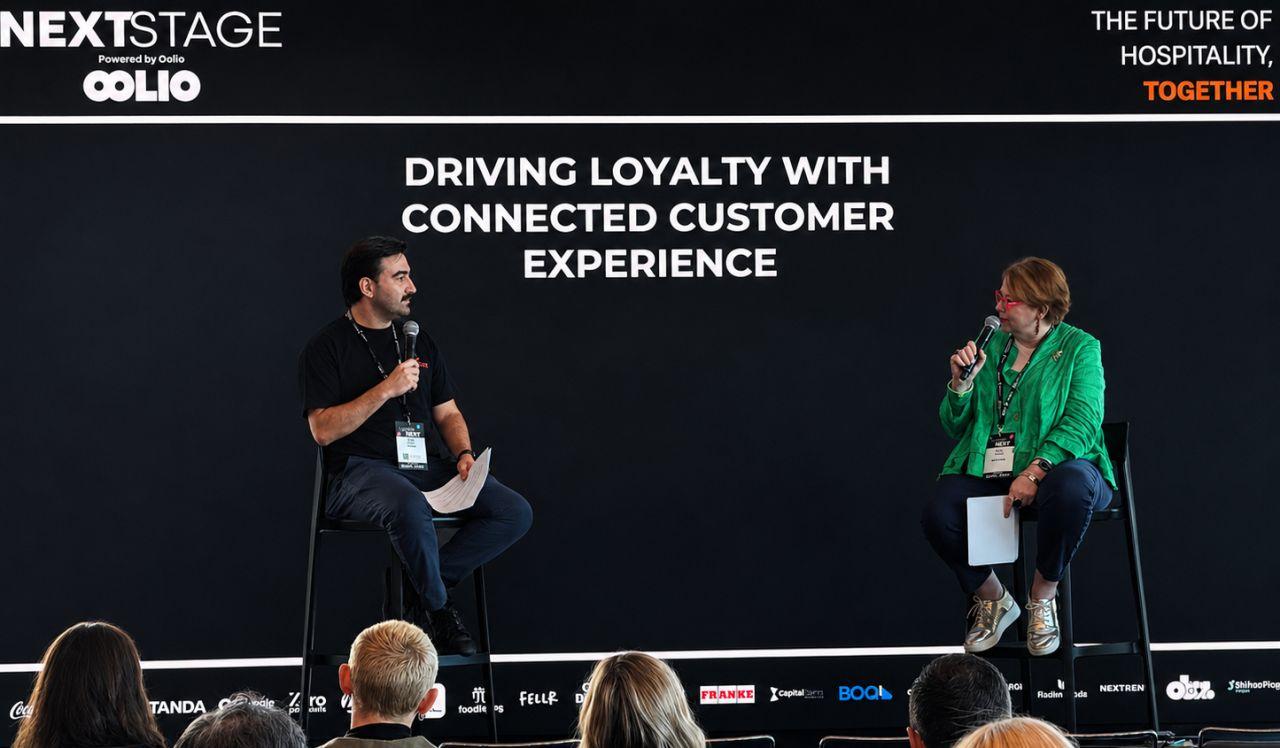
Chewzie Customer Onboarding Manager Simon Mason and Impact Data’s Head of Partnerships, Sarah Franklyn, recently discussed ‘driving loyalty with connected customer experiences’ at HospoNEXT.
The discussion centred around the key elements of your on-premise customer experience and how they can help hospo businesses drive loyalty.
Here are some additional thoughts on the topic and highlights of the conversation…
Why is loyalty important for business?
Hospitality is built on experiences; we need to create and cultivate experiences that make people get off the couch to come to a venue to dine, celebrate and even commiserate. But if every hospitality business had to attract every customer from scratch, they would go broke.
Having loyal customers is how you build a business. We call it small ‘l’ loyalty.
A loyal customer base is more than just a bunch of regulars; it’s about creating long-standing relationships that underpin your business. These relationships are important for many reasons beyond the financial. These customers are referrers and advocates for your business. If they love your place, chances are they will bring others to enjoy it or at least spread the word.
They are a set of eyes and ears when you aren’t there. They know your standards, and if they don’t get them, either their feedback or behaviour will be a big clue that something is up.
So a business without loyal customers will struggle, but how do you create that loyalty?
It starts with a great experience
What is a connected customer experience?
A connected customer experience is about seamless transitions between interactions with service and technology. This is where the customer experience actually delivers on the positioning of that venue – that’s probably the minimum to build a repeat visit, which is what can start the path to loyalty.
The journey starts with discovery, whether it’s socials, the website or even referrals or an introduction from a friend. The next step is then that the on-premise experience matches, or hopefully exceeds, my expectations. To achieve this, your technology needs to add to rather than get in the way of the experience. From a special order actually being executed properly to all the meals being delivered together, technology can make or break this experience.
Ordering is a particularly important part of that experience. Customers shouldn’t have to choose between convenience and service: the best technology gives them more control over how and when they order, while still feeling connected to the venue. It also needs to work operationally – sending each item to the right production area, capturing modifiers accurately and helping staff deliver the experience the customer was promised.
From the on-premise to the off-premise, this also needs to feel seamless. Friction is the enemy of a connected customer experience. When capturing your customers’ details for marketing purposes feels like a natural extension of placing an order, and a request for feedback receives a follow-up, these are the steps that can lead to the next visit.
How does creating customer experiences help to drive loyalty?
The reality is that it’s a step in the right direction but it isn’t the whole picture. If you want customers to come back, you have to ask them. It’s just like dating. To get a second date, you need to ask for one. And after a few dates, the relationship needs to evolve so you aren’t introducing yourselves from scratch each time.
Carefully selecting your technology partners and really understanding your customers’ experience are critical foundations to build loyalty on.
What friction points does an operator like Chewzie, which is deeply embedded in on-premise operations, see?
Depending on the way that you capture customer data, it may be a real point of friction in your service. Ideally you want the customer to complete sign-up forms to ensure accuracy and acceptance of terms and conditions and, importantly, permission to market.
At Chewzie, we reduce this friction by making it easy for customers to order as a guest, while providing a clear and compelling opportunity to stay connected with the venue. For returning customers, securely remembering their details on their device can make subsequent orders faster without forcing them through the same process each time.
We also see friction when loyalty and ordering exist as separate experiences. If a customer has earned an offer or belongs to a venue’s loyalty program, they should be able to identify themselves and receive the relevant benefit whether they order through Chewzie or directly at the POS. Tight integrations between ordering, POS, loyalty and marketing platforms make that possible without creating extra work for the customer or venue team.
The other side of the equation is operational friction. A seamless digital journey means very little if an order is sent to the wrong printer, a modifier is missed or the offer promoted in a campaign can’t be redeemed easily in the venue. The customer sees one brand and one experience, regardless of how many systems are working behind it.
And from Impact Data’s perspective, which sits outside the venue but is reliant on on-premise systems, where are the friction points that impact customer experience?
For us, the obvious ones are whether the business owns the data and how they obtain permission to market to them.
If you don’t own the right to exclusively market to your customers, it’s going to be more challenging to build a loyal customer base. You will always be in competition for their attention and spend.
The way that marketing permission is collected can have a significant impact on opt-in rates. We have seen that changing the message to a more compelling reason to stay connected with a business can have an immediate impact. We helped one business increase their opt-in rate by 14% in only a few weeks.
The other element a lot of brands don’t consider is the channel that the customer has opted in to. This is most relevant to SMS. There are a number of customers, often within a specific demographic, that prefer to receive communications via SMS. Brands must ensure they honour that in their selection of communication channels.
Actually, we expect the use of SMS to rise in importance now that SMS senders are being registered. This added layer of verification will reduce spam and scams and is likely to see SMS grow in importance.
So if we have delivered on a connected customer experience, what’s the next step to building loyalty?
Once you tick the on-premise experience off, the reality is that the next steps are about staying top of mind. This is so much easier if you own the right to connect with your customers. At Impact Data, we take the heavy lifting out of this by automating messages triggered at the right time and pairing them with a relevant Chewzie offer to drive customers back on-premise.
The offer can then be redeemed as part of the customer’s next Chewzie order, creating a measurable connection between the off-premise marketing activity and the resulting on-premise transaction.
Our data shows that customers who receive a behavioural date-triggered message are five times more likely to visit.
Can small ‘l’ loyalty be a proxy for a full-blown loyalty program?
Absolutely, and without the points liability!
The benefit of a partnership between Chewzie and Impact Data’s TalkBox platform is that TalkBox analyses the data that comes from a Chewzie transaction and updates each contact with fields such as days since last visit, average transaction value and days of the week visited.
These visits can also be counted and used in exactly the same way as a stamp card, except you never have to worry about losing your card. TalkBox can issue Chewzie vouchers that reward customers when they hit milestones, and even use a surprise-and-delight offer to create engagement and build the relationship.
If you could make one thing better in a connected customer experience to enhance loyalty, what would it be?
From an Impact Data perspective, it’s really about thinking through the journey from discovery to revisit and making sure you have actually tested the experience yourself. From making a booking to asking for the next visit, make sure you have experienced it all and it aligns to the experience you are creating when a customer visits.
From a Chewzie perspective, it would be removing the boundaries between the different ways a customer interacts with a venue. Customers don’t think in terms of POS, QR ordering, loyalty platforms or marketing databases – they simply expect the venue to recognise them and deliver a consistent experience.
If a customer receives an offer, they should be able to redeem it easily. If they’re a loyalty member, that membership should work whether they order at the bar or through digital ordering. And once they have visited, that transaction should help the venue make the next interaction more relevant. That is when separate pieces of technology start to feel like one connected customer experience.
Connected customer experiences aren’t created by a single piece of technology. They come from understanding the entire journey and selecting partners that can share information and work together across it. When the ordering experience, venue operations, customer data and follow-up communication are connected, businesses can remove friction, create more relevant interactions and give customers a genuine reason to return.
Contact Chewzie about your table ordering needs – https://chewzie.me/book-a-demo
